William Jones Yarwood (1812 – 1860)

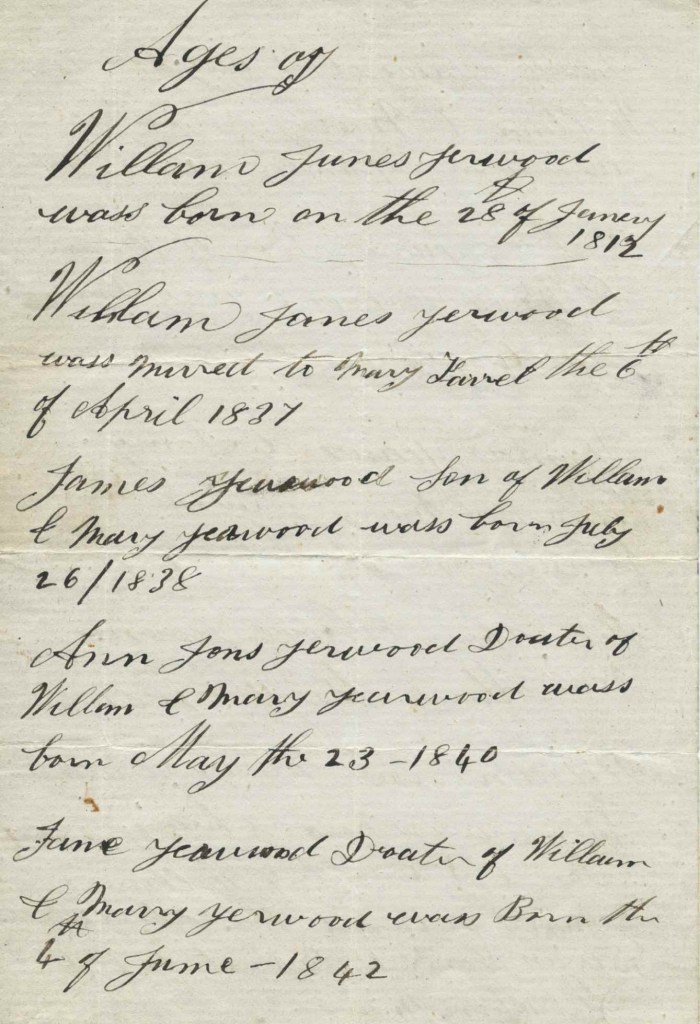
The first ancestor who ever caught my interest was William Jones Yarwood, whose name appeared on an old piece of paper in a box of old family memorabilia held by my (Great) Auntie Ethel. It is not clear who wrote the names but it is a list of babies born to William, my 3 x great grandfather, and his wife Mary Farrel, possibly copied from the Family Bible. When I first started researching online, William was not listed in the 1881 census and I forgot about him until quite recently. Lockdown in 2020 has given me a lot more time to devote to Ancestry and there are so many more research archives to find online now.

William Jones Yarwood was born on 28th January 1812, and records from the Parish Church of Frodsham (on Familysearch) confirmed his baptism date as 12th February 1812, and that he was the son of Joseph Yarwood and his wife Ann Jones. Also on that day, 12th February, William’s mother Ann was laid to rest in the same Church, the rector noting that she was from Ashton in the parish of Tarvin, a village some 6 miles south of Frodsham. What a sad day that must have been for the family. William had 2 older brothers and two sisters, all under the age of eight, now motherless.

It doesn’t look like Joseph remarried after the death of his wife and it is unclear who brought up the children, but unsurprisingly the young Henry got into a bit of bother, appearing in front of magistrates at the age of 23. I tracked down a newspaper report describing his misdemeanours. The sentence was incredibly harsh by any standards – sentenced to death for stealing a jug of ale! Luckily for his descendants (me!) the sentence was later commuted to 2 years in jail and immediately after his release in April 1837, William married Mary Farrel in Frodsham.
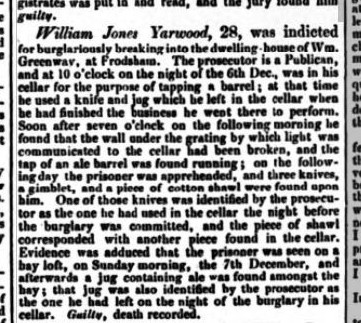
Chester Courant 7th April 1835 via The British Newspaper Archive

The censuses in 1841 and 1851 show that William worked as a Joiner Journeyman – which shows he settled down and completed his apprenticeship. I haven’t found any more court or newspaper records, although there is a record of a Mary Yarwood (possible his wife) in Cheshire being imprisoned for stealing Tuscan straw in 1839, however I have disregarded this as it happened a little too far from home and she gave birth in 1838 and 1840 so it seems unlikely she would have had the energy! The family were in Overton, a small hamlet near Frodsham in 1841 and at 55 Church Street, in the centre of Frodsham by 1851. There are records of William on an electoral register in 1840 as owner of a freehold house and gardens in Main Street, Frodsham, signs of some wealth and following William’s death Mary is listed as “Landed Proprietor”in the next two censuses. I need to do some further investigation to find out if this was money that came from Mary on their marriage or if he really did pull himself up by his bootstraps! I do hope so.

William died in Frodsham aged 48.

Henry Dootson (1798 – 1855)

Henry, son of Ellen Dootson of Atherton, 4 Nov 1798, Parish: Leigh, Lancashire
Ancestry.com. Manchester, England, Church of England Baptisms, Marriages and Burials, 1541-1812[database on-line] From Phillimore Ecclesiastical maps, 4820 [accessed 6 June 2019]

I can trace back six generations of Dootsons from myself. My father is Brian, then there was Will, William, Henry, Henry and the furthest back I can trace with a fair amount of certainty is another Henry Dootson (sometimes Doodson), born in Chowbent, Lancashire in about 1798.[1] Chowbent is 6km South West of Bolton and also known, especially more recently as Atherton. Henry was illegitimate[2] and the registers of St Mary the Virgin at Leigh show that his mother might have been Ellen Dootson.[3] It is possible that Ellen was born Collier and married to Samuel Dootson in 1789 – they had 3 children before Henry was born. I base this assumption on the fact that Henry named one of his children John Collier Dootson – a possible reference to his grandfather maybe. It could be that she was widowed and that was why Henry had no recorded father but I can’t find the death of Samuel so this is all pure speculation.

Atherton was famous in those early days of the Industrial revolution for its production of nails, and many men in the town were listed as nailors, including Samuel Dootson, Ellen’s assumed husband. How Ellen managed to survive or what her job was is not recorded.

Henry, however, seems to have moved north to Bolton, where there would have been more employment in the cotton factories. The population of Bolton more than doubled in the early part of the century, from 29,837 in 1801 to 60,143 in 1831.[4] He married Betty – or Betsey or Elizabeth – Radcliffe in Bolton in October 1819 in the parish church in Bolton-le-Moors, and so was part of this huge population increase. We know little about Betty – she might have come from Atherton with him – there are two Elizabeth Radcliffes of about the right age born in Atherton, but none born in Bolton. In the 1841 census we can see she was born in Lancashire, so it is also possible she was born elsewhere in Lancashire. Bolton-le-Moors was the old name for what we now know as Bolton, and in the nineteenth century it was split into Great and Little Bolton, although there are many different parishes or townships within the town.[5] I have tried to focus my research around Great Bolton as this seems to be where the family were located, around Black Horse Street, Derby Street and Vernon Street.[6] The records for the parish church in Bolton-le-Moors (later named St Peter’s) show that Henry and Elizabeth baptised 9 children between 1821 and 1839,  sadly burying at least 3 of these before their 2nd birthdays. This included John Collier who was born on Christmas Eve 1828 and died on New Year’s day.

For 20 years, from 1819 to 1839, Henry’s recorded occupation was a Sizer. This would have been a mill-based job, in a cotton or paper mill and involved covering the thread or paper with a solution of ‘Size’ in order to prepare it to take up the dye.

The hungry ‘40s must have been a very difficult time for Henry and his family. Economic depression meant that work dried up in the mills and food was very expensive because of a succession of crop failures. This was compounded by the Corn Laws, meant to protect the interests of the Tory landowners and stop the import of cheap foreign grain. By the time the corn laws were repealed in 1846, both Henry and his oldest son Henry had set up as Bread-bakers in different parts of Bolton. In the 1841 census Samuel Kirkman, married to Henry’s eldest daughter Marianne or Mary Ann was living with the family and working as a cotton carder alongside the younger Henry. In later censuses he too was employed as a baker in Moor Street , not far from Black Horse Street, so there does seem to be a family connection with baking.

In 1848, at the age of 50, Henry’s wife Betsy died and just 7 months later he remarried. His new wife was a widow called Jane Cooper. It is on this marriage certificate that we see the word “illegitimate” in place of his father’s name. His youngest child John was 12 and continued to live with them, along with 18 year old Elizabeth, although Jane’s children lived elsewhere. Henry died on 11th January 1855 of a strangulated hernia. He was 56.


[1] 1851 census shows his place of birth;

[2] 1849 certificate of marriage to Jane states he is illegitimate.

[3] https://lan-opc.org.uk/Atherton/index.html

[accessed 9 May 2019]

[4] http://www.visionofbritain.org.uk/unit/10057061/cube/TOT_POP

[accessed 9 May 2019]

[5] https://www.lan-opc.org.uk/Bolton-le-Moors/index.html

[accessed 9 May 2019]

[6] Great-great-grandfather Henry was living at Black Horse Street until the 1871 census, then moved within Great Bolton

The Dootsons in Bolton

I have tried to fix all my research to known facts about the family and our ancestors, but inevitably there has been some inference and guesswork. I have made some educated assumptions based on the facts that I know for certain and links between places and occupations. My grandfather, Will Dootson, always told me that his father’s family came from Leigh in Lancashire and the Dootson name and its variants can be seen in parish records in Bolton from 6 Jun 1636, when Sarah, daughter of Adam Doodsonn of Kersley, was baptised. Yet further back, in the records of St Mary the Virgin, Leigh, Elizabeth Dooson was baptised on 11 July 1596. In Atherton many of the Dootson baptisms are of illegitimate children, such as William Dootson, base-born son of Martha of Atherton, baptised 17 November 1712.[1] An analysis of surnames in the 1881 census shows that, while there were 5 people called Dootson living in Surrey, every other incidence of the name occurred in Lancashire (437 people).[2]

Church of St. Mary-the-Virgin, Leigh
www.lan-opc.org.uk/Leigh/stmary/index.html

[1] The searchable index to Lancashire Parish records is an invaluable source for researching this part of the world. http://www.lan-opc.org.uk/indexp.html

[accessed 26 May 2019]

[2] https://forebears.io/surnames/dootson

[accessed 9 May 2019]

The start

Sundays in the 1970s involved long afternoons visiting our elderly relatives. My grandfather’s sisters, Ethel and Connie never had any children, so their houses were not set up to entertain my brother Gordon and me. Auntie Ethel and Uncle Aidan lived in Withington, with Uncle Aidan’s elderly mother, Mrs Pollitt, next door. Afternoon tea consisted of tinned ham and salad followed by peaches and carnation milk and we had to sit and endure the polite conversation, or if we were lucky, watch the snooker. The highlight for me, however, was being allowed access to Auntie Ethel’s box of old certificates and photos. As well as the old sepia photos, there was a handwritten note, copied from an old family Bible stating the dates of birth of the Yarwood children, a death certificate for my great-great- grandfather and his wedding certificate from 1874. These were the oldest things I had ever seen, and they captured my imagination. I wanted to know who these people were, where they lived and what life was like for them. I wanted to match photos to names and find out how they fitted into family stories. It started me on the road to this research.